Friday, June 8, 2012

Don Mahaffey Should Write a Book

Recently there was a post on Turfnet about the Teachings of Don.  Here are some of my favorite quotes:

Common sense practical golf course maintenance strategies that result in lower overall costs yet still improve playability.

If you are not familiar with Don Mahaffey, he is a golf renaissance man, gifted with superintendent skills, a strong knowledge of golf course architecture–both neo-classical and post-modern–the ability to operate as both project manager and grow-in superintendent, an irrigation genius, a guy who understands business and shaping with a dozer.  Don blends all these skills together to create a philosophy of practical golf course construction and maintenance.

And Don's previous blog posts that Randy references:


Monday, June 4, 2012

An interesting putting green

In designing a pair of practice putting greens for a public course, I drew a set of green surfaces that included interesting, yet subtle contour. I was asked to redraw the green contours to be simple sloped planes to match those on the course.


It is a valid request, but these putting greens are where the new player will first meet the golf course, or maybe any golf course.  I'd rather it be an interesting meeting.


Their request inspired me to compose this quote: 


One neat element of a creative putting green is you can always find a straight or flat putt on one, but the converse is not true. 
You can never find a creative putt on a flat green. 
 -- Mike Nuzzo


The following videos, while very cool, show how predictable a flat planar surface can be:


Tuesday, May 15, 2012

Features and topography before a first site visit

I am visiting a new client this week. The project is to rebuild a green complex later this year, and look at some tee options. The course is 60 years old and has several different styles throughout. 


Prior to my visit I was able to compile a Google aerial image and recreate all of the golf features - greens, tees, bunkers, ponds & fairway. This is probably the most accurate set of feature areas in the courses history. I can now easily calculate the square footage of each green, tee, bunker...


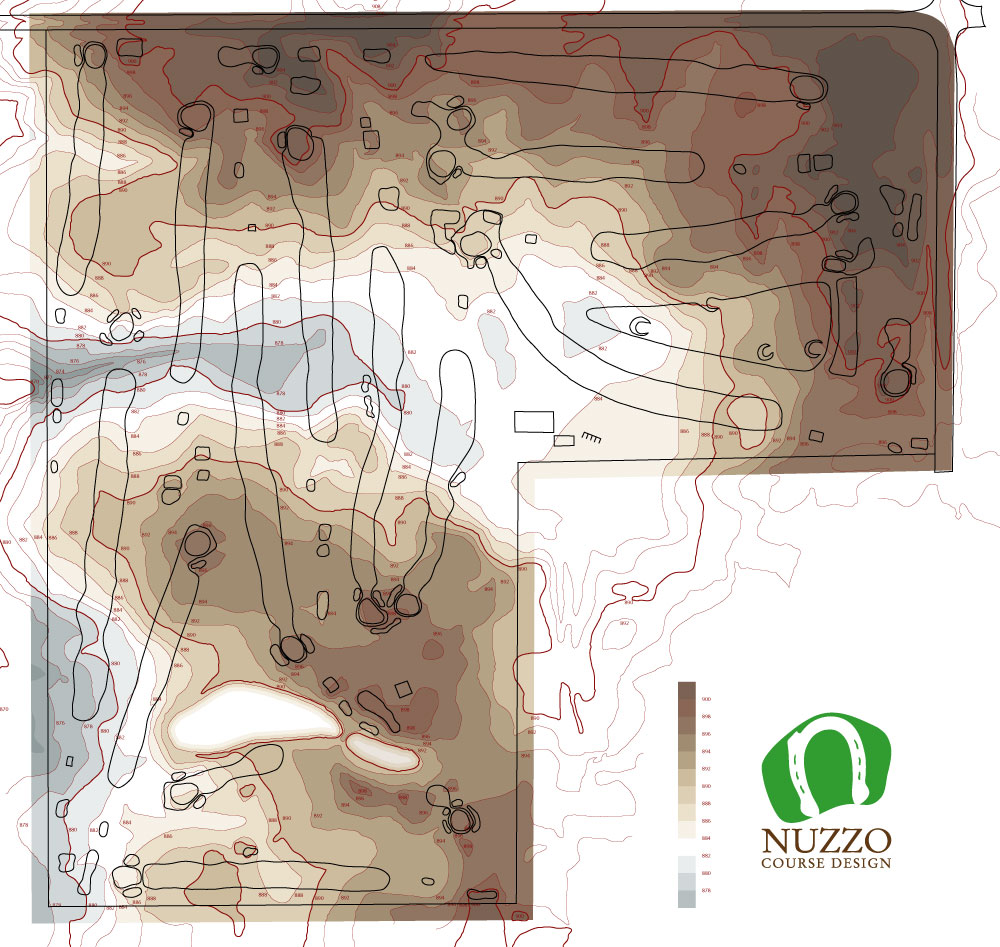
The superintendent also shared an available county topographic website, which I was also able to compile and chart. Above is the illustration I can bring to my first site visit to begin working on a specific problem and also start to work on a long term master improvement plan.


Every piece of information is now in one file and I will make any site visit notations or future design changes in this same file as well - everything will always stay associative.  Drainage, irrigation, earthwork, cart path or anything mapped via GPS.


As for the topo, the darker the brown the higher the elevation, the darker the grey, the lower. It is now easy to spot the valley along with the high and low spots throughout the course.


Research, facts and preparedness makes for a much easier site visit and better results.

Tuesday, May 1, 2012

Golf Course Economics by a factor of 28!

Sometimes we are asked how our methods are cost effective.  Our potential client may assume we cut corners or are over-estimating the benefits when we say we can complete a project for 30-50% less.  What would they think if we said we could perform a task for 4% of their planned budget.  They would certainly think we were nuts.


Here is the story.  A high end club has embarked on a bunker renovation.  They will be changing the bunker edge style and replacing the sand.  Why change the edge style?  To keep up with modern fashion I suppose, but it won't be long (5-10 years) before their changes are either out of fashion again, or the owners realize how much more these fancy new edges cost to maintain.  But I am not going to discuss maintenance costs, only capital costs today.


Listed below are the quantities and some estimates for this bunker project as compared to our imaginary one.  The Tonnage of sand is accurate.  One big difference the members of the high end club are anticipating is the color of the sand.  Their new sand will be white as snow.  This looks pretty and I can understand why some prefer this look.  Our sand is beige.  Their sand costs $100+ a ton, our sand costs $35 a ton.  Their sand gets transported across multiple state lines - gas is expensive.  Our sand is local.  The square footage number is calculated based on 4" of sand installed in a bunker.  400,000 square feet of bunker is absurd when the site isn't all sand to start.  This is where good design trumps over-design.  Their installation would include rebuilding all the new edges and has a cost similar to the material costs.  We would just replace the sand and clean up.


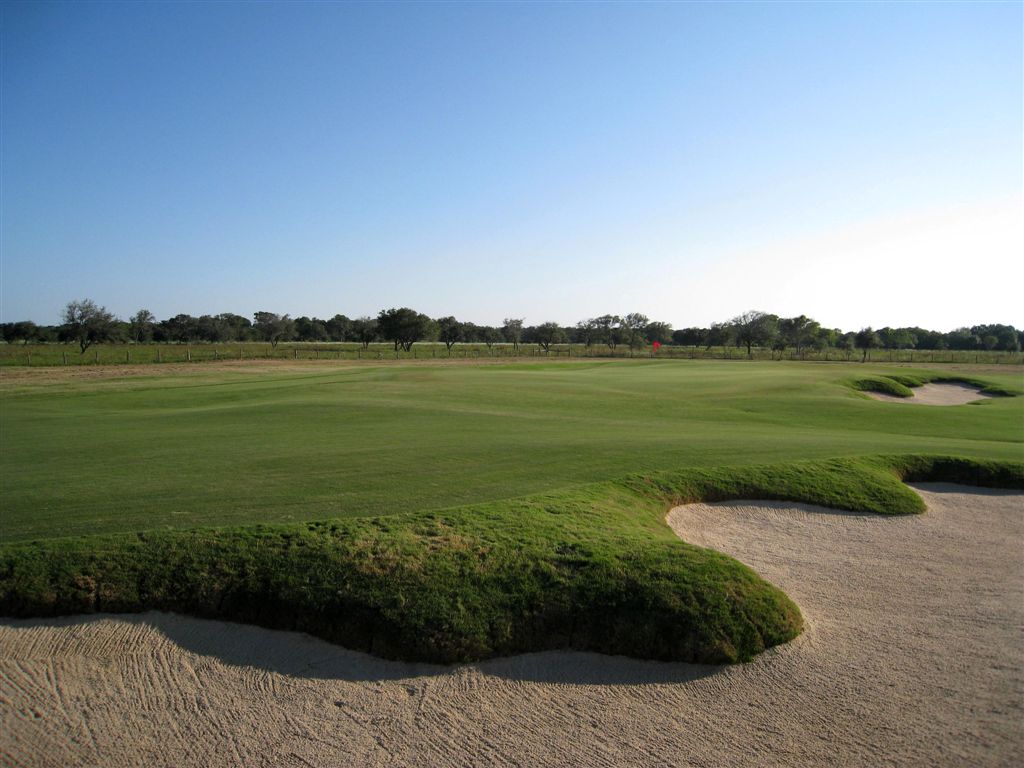
I've never told a client that replacing their bunker sand would cost 28 times more if you hire a different architect for the original design.  Maybe I should.  The picture above is one of our bunkers.


Lastly the industry says that bunkers should be rebuilt every 5-10 years.  We don't agree here either, but I sure hope no one tells the club that their bunkers will be bleach white forever.  They sure do try to keep 'em white however, by cleaning out every piece of debris in every bunker, every morning.  How much does that cost?  Did I mention how much sand they need to warehouse for regular maintenance and the facility they need to store the new sand?


The data:


High End Private Club Bunker Project
Tons Sand 7,000 
Price/Ton $100.00+ 
Distance (mi) 350 
Truck Loads 389 
Sand Price $700,000 
Cubic Yards 5,385 
Cubic Feet 145,385 
Square Feet 436,154 
Installation $700,000 
Project Cost = $1,400,000 


Wolf Point Club
Tons Sand 963 
Price/Ton $35.00 
Distance (mi) 20 
Truck Loads 53 
Sand Price $33,704 
Cubic Yards 741 
Cubic Feet 20,000 
Square Feet 60,000 
Installation $16,852 
Project Cost =  $50,556 


Cost Ratio = 28!!! times as expensive to replace the sand at the high end club as compared to Wolf Point.

Friday, April 27, 2012

Zen and the Art of Green Shaping & Finishing

Don Mahaffey has been working and consulting with a municipal course for 3 years. Starting this month they contracted Don rebuild 9 of their greens. We did some planning and came up with a number of good concepts that fit the site and will be more enjoyable for their players. 
For me, a most fun part is the fine shaping and finishing of the greens. It is a slow process, a lot like polishing a stone with lots of small circles.  The tool is a "mechanical bunker rake".  It  has a little blade in front to push around shovels of material and a rake in the back to smooth.
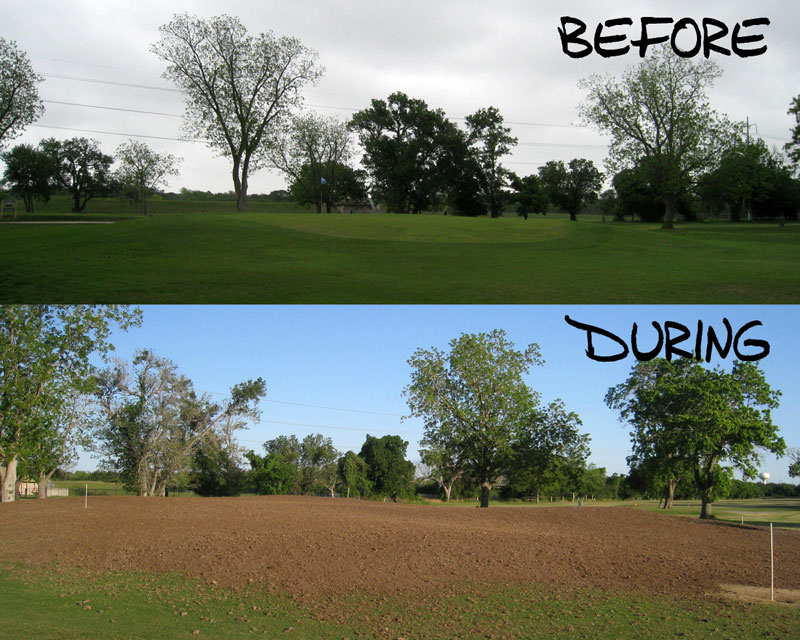
Above is a picture of the before and during. The green was tiny, too sloped for a hole and flat on top. When finished the 5th green will be more receptive to the average players shot and be far more interesting for putts and chips. We are using the materials on site and bringing in a little sand to perform the final finish in a week or so.
Another highlight is that Intern Rob has been working with Don for a couple years since helping to build the TPC San Antonio courses.  Last summer he and I had a nice project near Memphis.  Great music and even better ribs. 

Tuesday, January 17, 2012

Ron Whitten, Bandon Dunes and Don Mahaffey

Don Mahaffey (pictured above) and I have worked on a several projects and proposals since we created Wolf Point Club together. We have had a lot of chances to compare notes and discuss our ideas about golf and business. While our abilities are very different, our approaches are quite similar. 


Recently Ron Whitten wrote a blog post about Bandon Dunes with references to the Steve Job's biography. Don and Ron had somewhat different takes. Here is Don's: 


Jobs would have loved the idea of Bandon Dunes. My take is Jobs felt creating something beautiful at the intersection of creativity and technology was the key to good products. He did not focus just on one part of that, beauty was key, but the products had to be highly functional as well. Functionality was very important, but it had to be beautiful as well. After all that, it had to be simple. “Simple is the new sophistication” was his saying and he believed very much that it took great design to marry simplicity, beauty, and functionality together into something successful. Bandon Dunes has the Jobs’ pillars of success in spades. 


Bandon was created during an ugly period of excess in golf development. $10+ Million dollar courses with extravagant eye candy and multi-million dollar maintenance requirements was the norm to create a remarkable project. Keiser went against the grain and created something completely different. Jobs would have loved that. Jobs is quoted often in the bio as saying something along the lines of “the consumer doesn’t know what he wants until I give it to him” He didn’t believe in market studies or focus groups. He felt if he designed and built products that were simple, functional, and beautiful, then Apple would be successful. 


I have to believe Keiser felt similarly about his development of Bandon Dunes. For sure industry “experts” would have told him to build something more mainstream closer to population centers. But it seems Keiser felt if he built something great (simple, beautiful, functional) on a special piece of land, it might work.
 

Wednesday, January 4, 2012

Happy New Year: First round of 2012

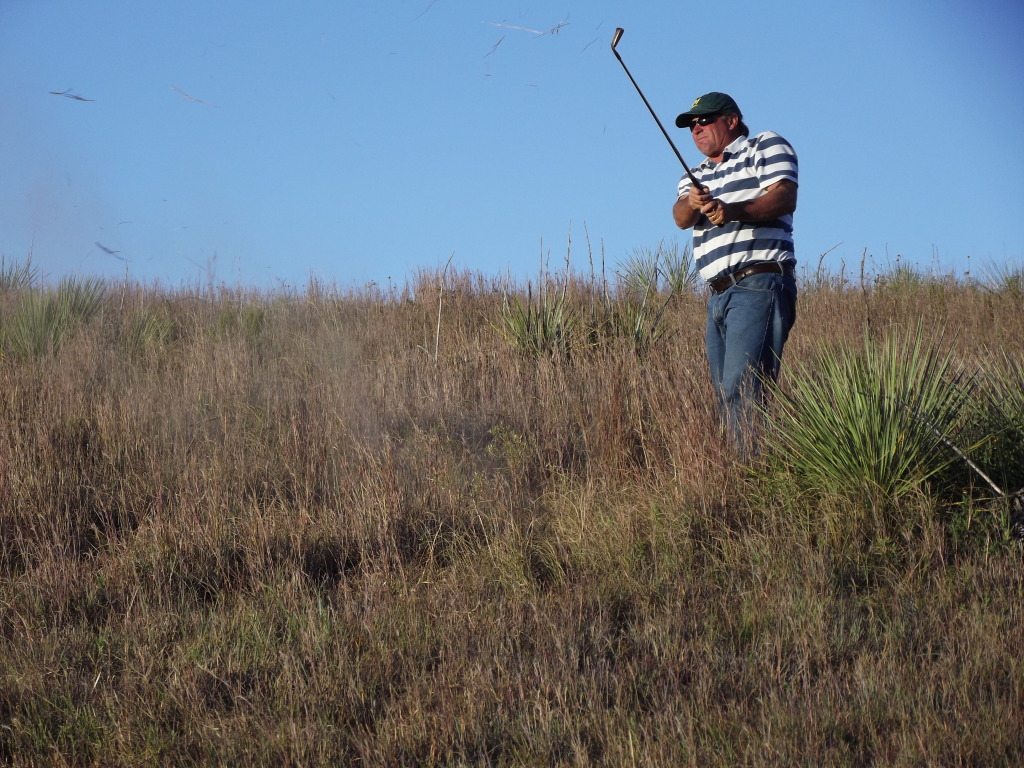
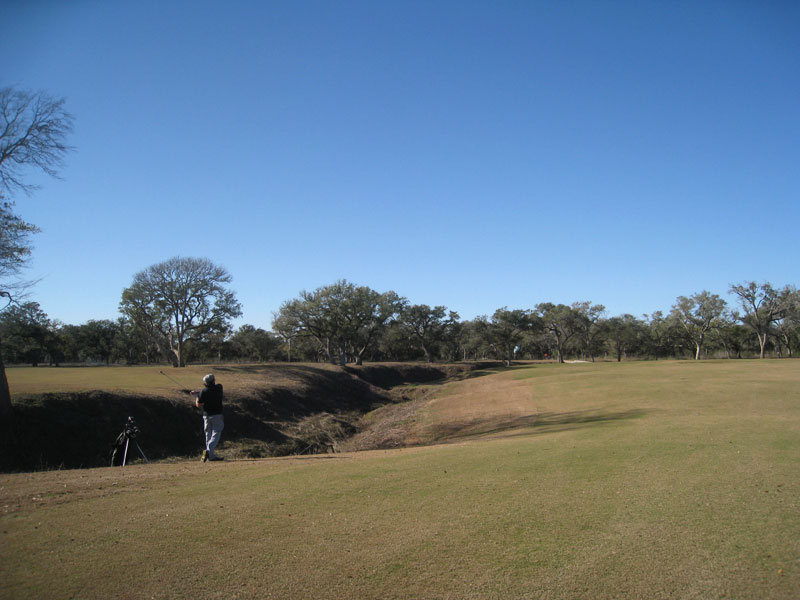
We started off the year strong, playing every day, until the 2nd anyway.  Pictured above is an old friend playing the shortish par 4 16th at Wolf Point Club.  He lost his tee shot in the creek, not taking my advice and keeping the tee ball right of the flag. The fairway slopes will draw the ball towards the creek. He did win the match on 17 unfortunately. 


"Completely original, and more like Scotland than any course I've played in the US." were his comments after the round. 


It was the first time I remember playing in a wind that came from the north-east - a 21 mph wind. It made for some interesting differences: I didn't carry the creek on 4, I birdied 5, I drove the 10th with a 4 wood and Jeff hit the longest tee ball on 17 I've seen yet - even with that crazy swing. 


Happy New Year

Thursday, August 25, 2011

Which golf hole would you rather play? The tees matter...

Both pictures are of the 13th hole at The Battleground outside Houston. The new tee above is what the player will see vs. the picture below, which is the old view.


They have a scenic lake that was barely visible from the old tee. Now the player can see the whole lake for a better sense of place. The old tee was blocked by the trees, away from the lake and the view was even blocked by the forward tees. We improved the angle a little for more interest based on hole locations. The electric power poles aren't lined up with the green too - this looks better and forces the better player use a less distinct target.

Originally The Battleground's par 3 tees were built way too small, a fraction of what they need for their number of annual players. We will be enlarging the tees and repairing many others, improving maintenance practices and aesthetics. The remainder of the work will happen this winter. We built four alternate tees to keep the course open during the next phase of construction.

The next phase will see a lowering of the forward tee, more tree clearing and a greatly expanded teeing surface.
Related Posts Plugin for WordPress, Blogger...