Wednesday, April 20, 2011

Cameron University's newest golf team member

Don's son recently committed to go to Cameron University and play on the golf team. They have a very fine team. There are lots of types of fun golf. Playing competitive collegiate golf is certainly one form. It is even more fun if this game helps one get an education.

Ryan spent most of his high school years prepping for football games under the lights. This was one of the reason's that helped Don move to Texas - his son wanted to play Texas high school football. And play football Ryan did! Starting both ways often on the line of scrimmage.

Since football has ended he has poured that same football commitment into his golf game. And boy has it improved over the last year.

Golf is a great game/sport, and it will have a lifelong impact on Ryan and his family.

Congratulations Ryan - have fun!

Wednesday, March 16, 2011

The Curious Case of Mike Nuzzo - Texas Golfer Magazine April 2011

This month's Texas Golfer Magazine has an article about me and our work. Carl, the writer, found Wolf Point listed in a somewhat obscure place. Having never heard of this course in his home state, he did some research and found me.
I'm very glad he did.

This is a fun quote from the article:
"To date, 517 humans have traveled into outer space.  It would be fair to guess that considerably fewer have played Wolf Point Club."

Here is a link to the article: The Curious Case of Mike Nuzzo
Or a link to the entire issue: Texas Golfer April Issue


p.s.
Please read the article 2 pages later about the great Mr. Jackie Burke Jr. and winning the Golf Writers Association Award.  Congratulations Mr. Burke.


And a small plug for the Red Cross
http://www.redcross.org/

Wednesday, February 2, 2011

Tiger's Dubai Desert Project, Al Ruwaya, and first NLE - Part 2

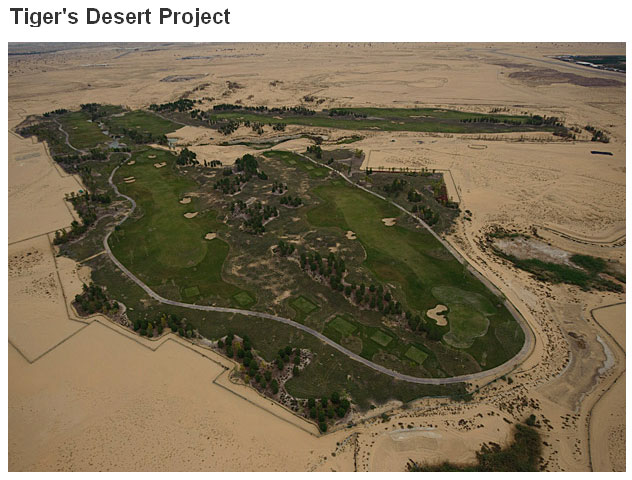
I remember the copy on Tiger's original design web site.  He said he wanted to create amazing golf courses - it has since been edited.  The hole pictured (Golf Digest pictures) above is a par 5 with 6! tees.  I can imagine it is very windy at times and that might be reason for extra tees, but I doubt it.  The 2nd & 5th tees are totally superfluous - who are those for?  Some of the best holes and courses in the world have just 2 sets of tees.  On to playability:  The first shot should stay left of the fairway bunkers - but doesn't look like it matters - because the 2nd shot will just find the fairway too with little advantage for attacking the green - the angles are too narrow.  The bunker in front of the green may be a nice touch and give the few people in the world who can reach the green in two some concern.  Everyone else will try to hit the fairway twice then the middle of the green.  This hole is not memorable - nice - but certainly not memorable - I wouldn't call it amazing, unless spending more money on a golf hole than any other on the planet is part of the criteria.  They do get a point for not making lacey edged bunkers that are so in vogue these days - they are clearly Fazio bunkers though - using one of their shapers is my guess.


The previous hole, a par 4, looks like store brand vanilla ice cream. A tee shot between two bunkers to an angled green.  That's it.

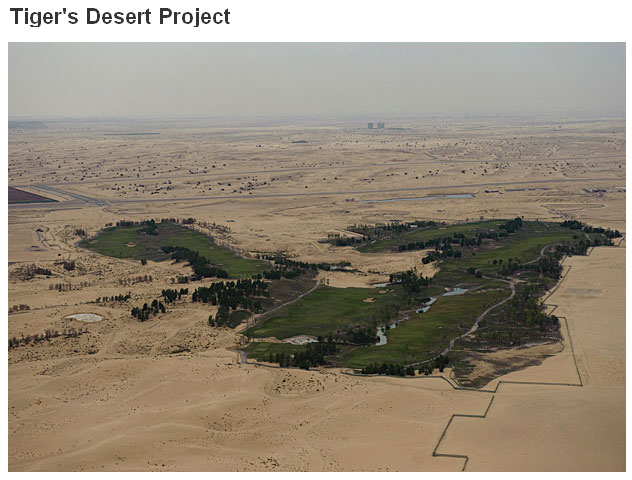
I'll guess the grass is Paspalum - a warm season grass that does well in high salt environments. The water comes from a desalination plant - this lush vegetation requires a LOT of water. Golf courses do best - look and play - when they blend into the native environment. The course isn't fighting nature and it looks like it fits.


I have one last picture to describe for tomorrow.

Tuesday, February 1, 2011

Tiger's Desert Project, Al Ruwaya, and first NLE

Tiger Wood's first golf course design project was being developed in Dubai. As of yesterday it was announced that the project was cancelled. NLE = No Longer Existing, and it is usually the term when an old golf course closes - there have been a few notable modern ones in recent years. I thought it would be interesting to analyze the course architecturally speaking. From Tiger's website: Par 72 championship-quality course. The vision for Al Ruwaya Golf Course is to transform the blank canvas into a unique golf course that rivals any in the world.

Tiger teamed up with a former Fazio associate to create his design firm. (That former associate also has his own firm with no mention of Tiger on their website.) The following are my assumptions.

The project was to sell about $1 Billion dollar's of real estate. With that as the goal you can rationalize almost anything - like a reported $10-20 million design fee - but it is all still a guess for the owners. One of Fazio's most famous and successful golf course designs is Shadow Creek in the desert outside Las Vegas. I believe the cost for construction was over $40 million dollars. I assume this was the model for Al Ruwaya - to create an oasis.

Pictured above is an image of the project from Golf Digest. I see a very densely vegetated area = a lot of water too keep everything alive. There are 5.5 holes constructed with grass. The hole corridors appear to be somewhat wide between holes - there looks like as much to irrigate outside the hole as the hole itself - which translates to at least twice as much maintained area for non-playing surfaces - you can irrigate a lot less around tees until you get to the fairway. That is very expensive and doesn't effect the playability of the hole.

There appears to be some shaping in the fairways - not just surrounding the hole - they get a point for this work. And they get another point for keeping the holes together - not every hole is lined with houses. But they loose that point quickly with the distance between greens and tees - not that anyone will walk here, but there is no need to separate when a good angle will do just fine.

I am thankfully keeping busy with my own work - this post was written during a break - so I'll get to more in the next day or two.
Cheers

Tuesday, January 18, 2011

A couple of media mentions

Last week Nuzzo Course Design was mentioned in a couple places:

I was asked to be a judge for Golf Inc Magazine's annual development of the year awards.
Some were nice, but most were still overdone.  Some of the best golf courses in the world have been built on practical budgets.  I don't think many developments are marketing to players.  Pretty pictures will bring someone down once.  The golf course had better be really good if you want them to come back.

Here are a few of my comments about the nominations:
  • At that price I’m not sure how the mission could be achieved. The ride from 9 to 10 is one of the longest I have ever seen. Too much water for the public golfer to enjoy regularly.
  • Too much water, way spread out, over done bunkering.
  • Does not blend seamlessly into the native environment – not even close. Lots of water and 11 parallel hole corridors – 8 of them side by side.
  • The routing appears a bit disjointed with some large separations between holes. Some of the shaping and features are overdone, and some of the bunkering looks really good and original.
  • Nice to see non-returning 9s, fewer restraints usually leads to a better course.
  • Some pictures show good restraint and very nice golf holes, others seem to shout look at me.
  • Would have done better with fewer and less busy looking bunkers.
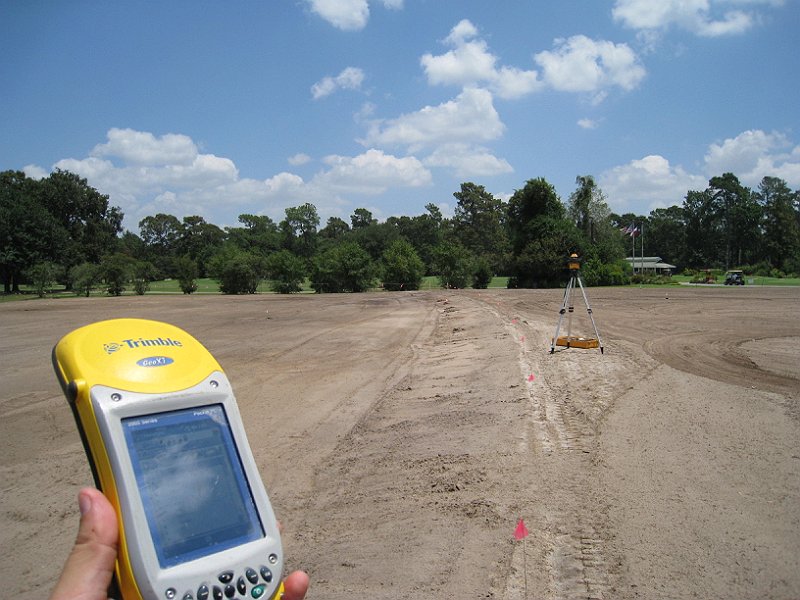
There was also a brief mention of some of my work at Champions Golf Club in Golf Course Industry Magazine.  The picture above is during the range renovation at Champions.  In the foreground is a sub-meter GPS measuring device.  I can map my designs on to the ground and record what happens in the field as we go - to make sure the irrigation is efficient and in this case to get the tee line oriented perfectly.  In the background a laser is used to measure the finish work and helps keep the tee perfectly on plane.

Wednesday, December 29, 2010

My grandfather introduced me to the game of golf and so much more.

I can remember my first round of golf ever. It was at a little nearby pitch-n-putt course. It was with my grandpa, Jim, who is furthest to the right above. He and my father introduced me to the game. I am very fortunate that we got to play so many times together over a 30 year period. And so very sad to have lost him Tuesday. He was 86.

He was an Air Force pilot, he ran his own business, he gave me my first stock, and he taught me how to play the game. He had an incredible feel. I can vividly remember him holding my young hands and working on my grip while we would chip heaps of balls to the laundry pole in his back yard.

One day when I was in my 20's, we were playing at his home course, Sunset. The greens there were so fast that he used to say, "On in two, off in three." He watched me putt off a few greens in our times there. We were both on the first green in two, and grandpa was warning me about the putt. The pin was in the back up against the steepest part of the green - actually a nearly impossible place for the flag. He encouraged me keep it below the hole. I was still young, and I sent my ball heading past the cup, but at just a right speed so that it passed by the hole up the slope and rolled back down into the middle of the cup. Birdie! He looked at me half with a wink, half with a wily grin. I think we started playing competitively at that moment. Our games were at a similar level for many years. There was an extended period where for several matches in a row, not only did we tie, but also at the same score.

We last played together a couple years ago. It felt like it was going to be our final round. I soaked in every minute and reveled in seeing him play - he still had a great touch. I was chuffed to hear that later he and my aunt started playing at that very same pitch-n-putt course.


I moved to Texas in 2000 - much less golf together, but more phone calls. Every phone call I would tell grandpa I loved him. He knew what to do if his B-29 was falling out of the sky; it did once. He wasn't used to having someone tell him he loved him over the phone. So after several years of getting used to saying he loved me too, one day he beat me to the punch. His exact words were, "I love you. Ha, I said it first!"

The love was always there, it was just a little easier for him when he made it playful. Just like when we played golf together. There wasn't a moment on, or off, the course that we didn't know that we loved each other.


I love you grandpa.

Monday, December 13, 2010

"Wolf Point is a jewel"

Pictured above is our 7th green taken just a few days ago.  2010 has been a challenging year for the blog as well as business.   I've been working on leads from around the world, and that has slowed down my ability to post and limited what I can comfortably post. In January I will share some near misses, projects in the works and hopefully tales of one course ready for some improvements.

It is still the rare bird that gets to see Wolf Point... and this is what the last visitor/potential client had to say:

"I love your design work. The course is a jewel."

Tuesday, November 16, 2010

Golf course native areas naturally

Scott J Morrison from Turfhugger recently found something interesting on my website and asked me a few questions about what we did at Wolf Point. The following is from the Turfhugger blog:

"We let the native areas come back naturally without irrigation. Typically irrigation is installed to establish the perimeter and then abandoned after grow-in. Using the irrigated method causes the grow-in to be thicker than the native environment and is a continual maintenance battle to thin out."

This statement demonstrated 3 things to me...

First, the natural areas in reference were not an afterthought or "filler", nor are they a fancy "look how green we are, our natural areas grow quicker than our turf" statement. I've seen that at a few courses where public opinion of the golf course was not exactly supportive. Of course successful establishment is key to long-term health, but there's a difference between "gardening" and "natural".

Secondly, water conservation is a primary goal even during course grow-in. This is seldom the case in most projects who often rush to have picture perfect conditions of all things on the property right off the starters block.

Third, a management plan considering season and competitive non-native species had to be implemented simultaneously.

So I asked him to expand on this statement with an example, this is what he had to say...

"When Don Mahaffey and I built Wolf Point there was a single mandate, minimize lost balls in long grasses and keep the course challenging and interesting enough to play every day. That translated to 80 acres of fairway and no rough.

We planted Emerald Bermuda on the greens and surrounds and 419 in the fairways. We considered Emerald across the entire course, but decided on 419 in case we ever wanted to grow a rough. The Gulf Coast of Texas gets 45 inches of rain a year on average – sometimes all in one month.

We viewed our irrigation system more as insurance vs. required worst case perfect coverage. Our client could withstand some mottled looks at times. We chose a large rotor spacing and minimized use of part circles. Even around the greens we used full circles – the greens construction was similar to the surrounds there is no reason for ins and outs. We used this approach around the perimeter and outside of the fairway too. As a result the edges get less irrigation than where there is head to head coverage.

Then we transitioned to the native areas where we have no irrigation. It took a little time for any disturbed areas to re-establish, but at no cost. Don spread a wild flower mix in some areas that have grown periodically. Today outside the playing surfaces the area looks natural because it is natural. It is cleared annually and changes with the seasons. "
Related Posts Plugin for WordPress, Blogger...